
Pueblo City Directory Collections
Pueblo’s historical city directory trail is broad, but it is not one uniform online file. The Pueblo Historical Society reports a complete city-directory run beginning in 1871, while the Rawlings catalog shows R.L. Polk volumes, J.A. Blake material, telephone books, school-district directories, and Colorado business directories with Pueblo pages. The publisher and edition matter. A catalog hit can describe a physical volume, a partial scan, or a related directory rather than a searchable list of every Pueblo household.
| Collection | Years | Where Held | Access |
|---|---|---|---|
| Pueblo city directories | Complete run reported from 1871; editions vary | Historical Society and Rawlings catalog/reference collection | In person, catalog, or a digital item when available |
| Street-name sections | 1914-1927; separate list in back after 1927 | Rawlings, following the Historic Pueblo house guide | Address-to-occupant work; verify the edition |
| Pueblo Chieftain microfilm | 1868-1970 | Historical Society and Pueblo City-County Library District | Microfilm readers and current library resources |
| Obituary archive | Scanned listings; later records use an assistance route | PCCLD obituary page and Rawlings | Name search, free PDF scan, or mailed copy |
| Pueblo Sanborn and map sets | 1905, 1917, 1920, 1922, 1941 | Library of Congress, library, and city packets | Online item or in-person historical comparison |
Some years and scans are not presumed to be online. The Historical Society is the strongest first stop for a missing printed year, while Rawlings can test the catalog record, reference shelf, local digital collection, and microfilm route. The PCCLD Digital Collections page is a useful search door, not a promise that every directory edition has been digitized.
Pueblo Historical Directory Shelf
The Edward Broadhead Library at the Southeastern Colorado Heritage Center, 203 W B Street, is the physical anchor for a Pueblo directory search. The Pueblo Historical Society describes a complete run from 1871, more than 200 maps, Pueblo Chieftain microfilm from 1868-1970, yearbooks, a cemetery list, more than 200 oral histories, and about 50 vertical files on local people, events, and places. The collection is free to the public Tuesday through Thursday from 10:00 a.m. to 4:00 p.m. and Friday from 10:00 a.m. to 1:00 p.m. Appointments help when a question needs longer handling time.
Call the library at 719-543-6772 or write to info@pueblohistory.org before traveling with a narrow question. Ask for the edition year, publisher, page, and whether the lookup used an alphabetical name section or a street listing. A cemetery entry, oral history, or vertical-file clipping can add a name variant, but each remains a lead that needs a date and a second source.
The Pueblo Historical Society library page shows the collection’s local shape and public access details.
The library’s maps, newspapers, and vertical files make an old directory entry easier to place in Pueblo’s streets and neighborhoods.
Rawlings Directory Indexes
Rawlings Library’s Local History and Genealogy service works from the third floor at 100 E Abriendo Avenue. The local-history desk, reached at 719-562-5626, can help with the catalog, reference holdings, microfilm readers, local newspapers, photographs, and directory questions. The catalog’s subject search showed approximately 413 directory-related results at inspection, including roughly 356 available and 54 online. Those counts can change, and one inspection returned an access error, so the physical or staff-confirmed holding controls the conclusion.
The Rawlings catalog is broader than the phrase directory suggests. Results include Pueblo books, Pueblo and nearby telephone directories, school-district directories, Colorado state business books with Pueblo pages, and J.A. Blake editions from 1878 into the 1900s. Read the item title and format before assuming that an online label means a full scan. The library also cautions that not everything is online, some material is viewable only in person, and licensed genealogy databases can change.
For a second online route, the Rawlings directory catalog search can identify a title, while the PCCLD ContentDM collection can expose selected digitized material.
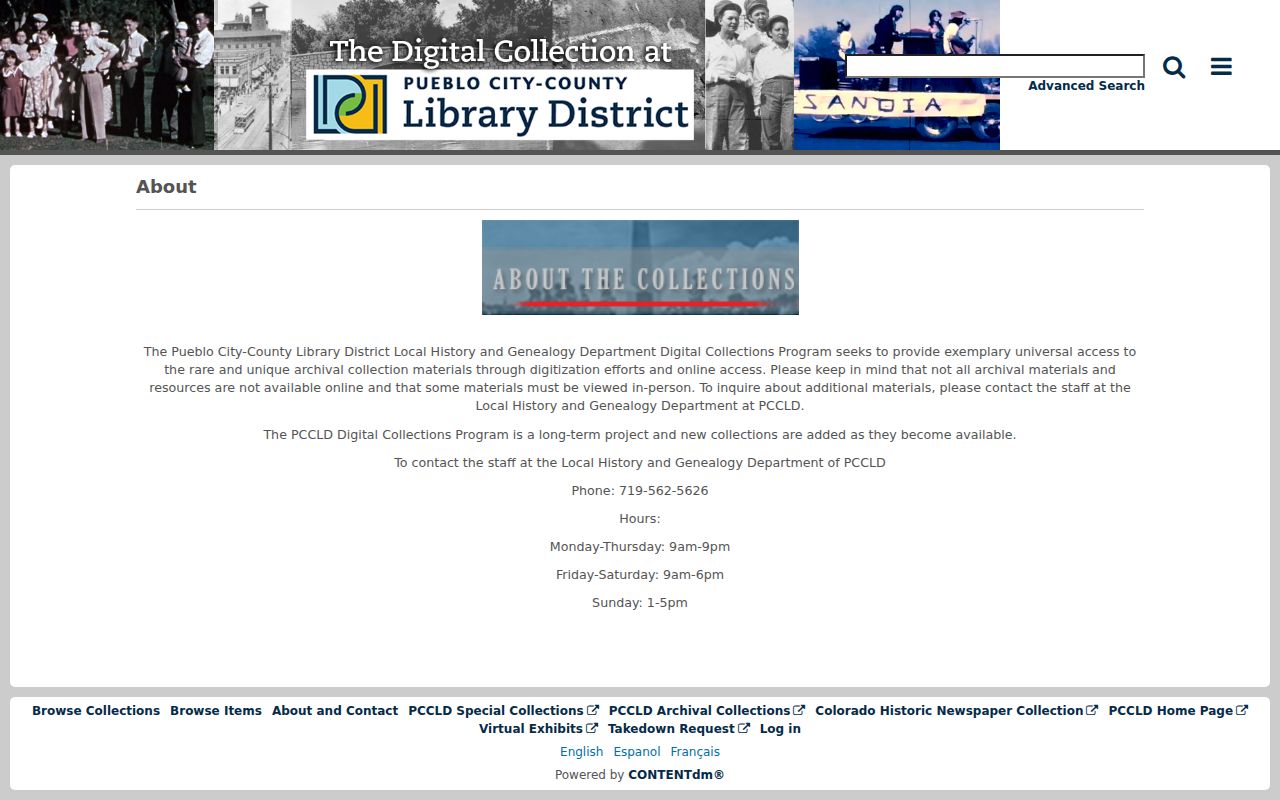
A digital landing page is best used to capture an item title and date; it should not replace a shelf check when a year or page is missing.
Pueblo Street Lists in Directories
Historic Pueblo’s home-research instructions give the most useful shortcut for an address question. Street-name listings begin in 1914 and run through 1927. After 1927, a separate street listing appears in the back of the volume. Before 1914, page-by-page inspection may be necessary. Preserve the old spelling and number before trying a modern address, because renumbering, renamed streets, annexation, and directional abbreviations can break a name-first search.
The official inventory for 412-414 N Santa Fe Avenue, resource 5PE.1200, demonstrates how much a street list can hold. In 1914, T.J. Downen appears at 412, G.W. Johnson at 414, and W.T. Hickman at 414½. The 1915 extract adds Schultz Engraving Co., Johnson’s Cigar Store, Walls’ Frogless Switch, and Mary Hickman. Later years continue through 1957. Label each line as a person, business, occupant, or address use.
Address tip. An older Pueblo directory can preserve the clue needed to find a current parcel, but an address match still needs map, deed, or official inventory support.
Pueblo Directory Years and Publishers
The reported 1871 beginning of the Pueblo run is a starting marker, not a claim that every edition has the same layout or publisher. Rawlings catalog results name R.L. Polk volumes and J.A. Blake material, along with telephone, school-district, state business, and other local directories. A year-by-year search should record the title page, publisher, edition, repository, and page or reel. That citation explains why two books with similar names may place the same person under different abbreviations or sections.
| 1871 marker | The Historical Society reports a complete Pueblo city-directory run beginning in this year. |
|---|---|
| 1914-1927 bridge | Street-name sections provide an address-to-occupant route, with page work still possible when an index is thin. |
| After 1927 | Historic Pueblo says to check the separate street listing in the back of the volume. |
| Publisher clue | R.L. Polk and J.A. Blake appear in Rawlings catalog material; verify the actual edition. |
No single public source in the research establishes one final printed year or a complete online run. That is a useful research gap to state plainly. If a catalog item is marked online, save the item record and inspect whether the scan covers the needed directory, its index, and its abbreviation key.
Reading a Pueblo City Directory Entry
A Pueblo city directory entry is a dated source line, not a modern resident profile. Start by copying the name exactly, including initials, spelling, honorifics, and any business name. Then capture the street number, street form, occupation or business description, edition year, and page. A person at an address may be an occupant, a property owner, or a business contact. The directory itself may not settle which role applies, so the citation must preserve the wording rather than silently turn it into a claim about residence.
| Identity | Copy the person or business name as printed, including initials and spelling variants. |
|---|---|
| Placement | Record the house number, street, unit or half-number, and any direction or suffix. |
| Date | Save the edition year and page so a later move is not confused with a missing record. |
| Role | Mark whether the line is a person, business, occupation, owner clue, or other printed use. |
| Source note | Identify the publisher, repository, scan or microfilm reel, and the section searched. |
The Santa Fe sample shows why the role field matters. Schultz Engraving Co., Johnson’s Cigar Store, and Walls’ Frogless Switch share the 1915 address extract with named people. A directory can therefore document mixed use at one number without proving that each name belongs to a household.
- Criss-cross directory
- An address-ordered section that lets a researcher move from a street and number to the names printed at that location.
- Householder index
- An alphabetical or name-based aid that points to a person’s entry; it may not list every occupant.
- Abbreviation key
- The volume’s explanation of short forms and symbols. Find it before interpreting a mark, then cite its page.
Pueblo Address Evidence Beyond Directories
A city directory becomes stronger when it is placed beside a map, deed, or preservation packet. The Library of Congress Pueblo Sanborn material includes related sets for 1905, 1917, 1920, 1922, and 1941. A Sanborn sheet can show a footprint, street number, land use, and neighborhood setting. It is not a current person register, but it can test whether an old number and building form fit the address described in a directory.
The City of Pueblo historic inventory for 412-414 N Santa Fe is one local model. Resource 5PE.1200 reproduces directory extracts through 1957 and shows people and small businesses changing around the same number. The 314 W 18th packet, resource 5PE.5762, is another model that combines directories, assessor material, Sanborn, obituaries, and census. It identifies Edward C. Teller around 1918, Turner S. Underwood in 1925, and later named people. Those names illustrate source reconciliation, not a universal ownership rule.
The City of Pueblo’s Bessemer neighborhood context gives a useful completeness test. Its 1886 directory count names 188 residents, including 175 men and 13 women, while about 80 people lacked street numbers. A count can therefore be exact for named people and still weak for an address search.
Use the Library of Congress Pueblo Sanborn item with the City packets when an address appears to change. Keep the map sheet, directory edition, and resource number together in the research note.
Chieftain Clues Beside Pueblo Directories
Pueblo Chieftain microfilm at the Historical Society covers 1868-1970 and can add a dated name, organization, address, or family clue beside a city directory entry. The Pueblo City-County Library District obituary search provides Last Name, First Name, Sort by, Order, and Apply controls for scanned listings. A free PDF scan is the quickest route; the library reports a $3 USPS copy option and says mailed copies may take about 90 days. For records after 2011, the listed assistance number is 719-562-5623.
An obituary is family-supplied material. It may establish relatives, a funeral home or organization, a death date, and a place clue, but it should be compared with a directory, cemetery list, vital record, deed, or other official source. A newspaper notice can explain why a name disappears from later city directories without proving exactly when the person left an address.
The PCCLD obituary search shows the available search path and copy instructions.
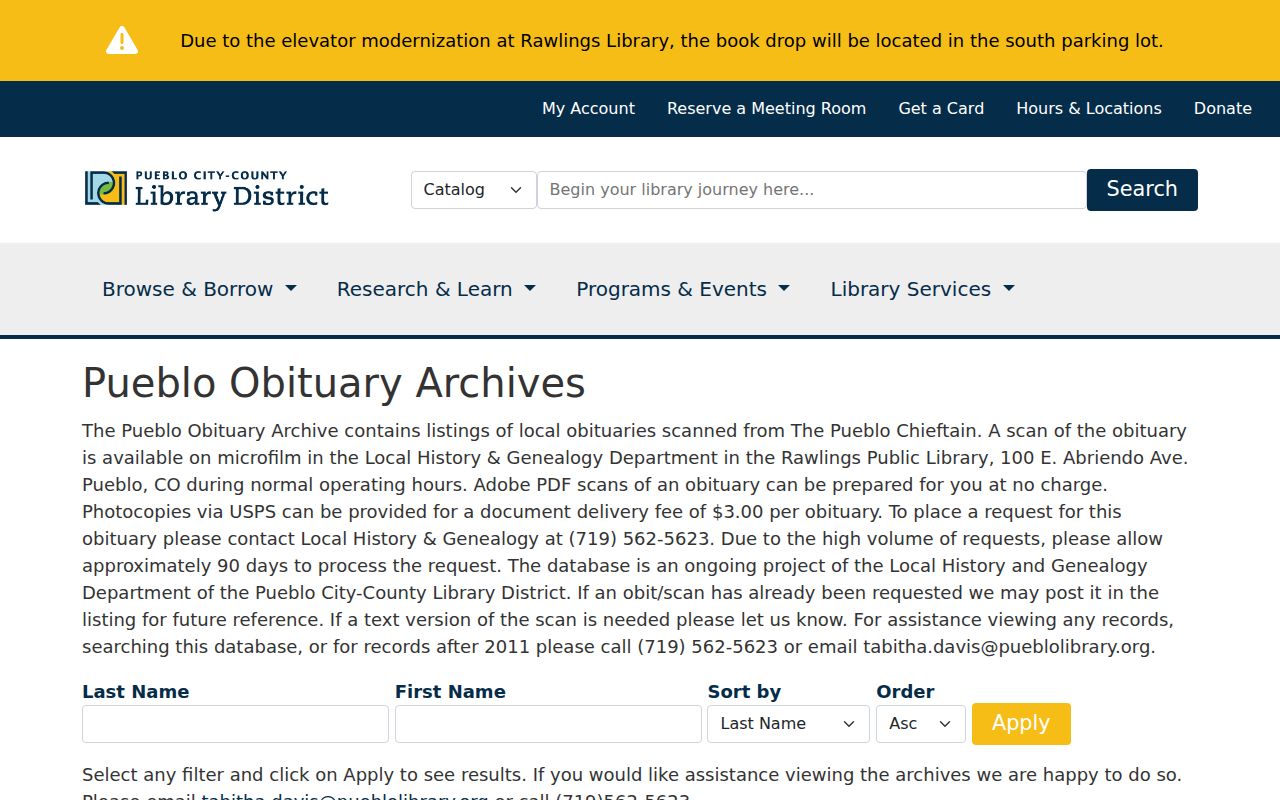
The search fields help narrow a notice, while the scan itself supplies the page-level evidence to cite beside the city directory entry.
Using Pueblo Directories for Family History
Trace a Pueblo household as a sequence of dated appearances, not as one uninterrupted record. Start with the most certain name and address, then work across editions while recording every change. Census schedules fill wider gaps between directory years, and an obituary or cemetery entry can explain a final appearance. When a historical name needs present-day confirmation, a Pueblo resident lookup can test a separate official record without turning the old directory into current residence proof.
- Find the first plausible appearance and copy the name, address, edition, publisher, page, and repository.
- Read later Pueblo directories year by year, keeping old street forms and noting moves, businesses, or changed abbreviations.
- Check the street-order or criss-cross section when the name index is absent, incomplete, or hard to read.
- Pair directory years with the nearest available federal census schedule, recording the enumeration district and household relationships.
- Close the trail with a Chieftain notice, cemetery list, obituary scan, or a targeted archive file, then label the result as a dated clue.
A disappearance can mean a move, death, a skipped edition, a changed spelling, or an entry that was never included. Compare the next directory with newspapers, maps, and the Recorder before choosing one explanation. The Historical Society’s vertical files can be worth asking for when a name appears in a local clipping or photograph but not in a catalog search.
Pueblo City Directory Access Routes
Online access starts with the PCCLD catalog, the ContentDM digital collection, the obituary search, city historic-property PDFs, the City of Pueblo Archive Center, and Library of Congress map items. These routes can identify a title or provide a scan. They do not replace the physical shelf when a missing year, page, reel, or abbreviation key controls the result.
In person, use the Historical Society library at the Southeastern Colorado Heritage Center, Rawlings’ third-floor Local History and Genealogy service, microfilm readers, and the relevant City or County office. Phone and email routes include the Historical Society at 719-543-6772 and info@pueblohistory.org, Rawlings at 719-562-5626, and the obituary assistance line at 719-562-5623. Ask for an exact edition, page, reel, map sheet, cemetery record, or vertical file rather than a broad name list.
Mail remains useful for an obituary copy and for a targeted county or Recorder request. For a deed or ownership cross-check, the Pueblo County Clerk & Recorder’s Recording Division is the named custodian at 215 W 10th Street, second floor, with 719-583-6507, recording@pueblocounty.us, an official records search, and a counter route. A City of Pueblo historic-property file, map, agenda, or retained archive can be requested through the city’s CORA route when it is not online. The Colorado State Archives finding aids and research room add marriage, naturalization, and probate series for older names. Catalog counts and digital availability are not fixed, so save the access date and the custodian’s response.
Note: A complete reported run does not guarantee a complete searchable scan, so record the physical repository and edition before citing a directory.